Frank Zappa was very clear about what he thought
about many things- from art and music to politics
and censorship in the USA.
What he said was always informed
and worthy of consideration...
“You can’t write a chord ugly enough to say what you want sometimes, so you have to rely on a giraffe filled with whipped cream.”
“My best advice to anyone who wants to raise a happy, mentally healthy child is:
Keep him or her as far away from a church as you can.”
“It isn’t necessary to imagine the world ending in fire or ice. There are two other possibilities: one is paperwork, and the other is nostalgia.”
“Some scientists claim that hydrogen, because it is so plentiful, is the basic building block of the universe. I dispute that. I say there is more stupidity than hydrogen, and that is the basic building block of the universe.”
At a Congressional hearing about parental advisory labels on records, Frank said to Tipper Gore,
“May your shit come to life and kiss you on the face.”
In 1964, Ray Collins formed a band called The Soul Giants with drummer
Jimmy Carl Black, bassist Roy Estrada, saxophonist Dave Coronado,
and guitarist Ray Hunt. Not long later, Collins got into a fight with Hunt,
who left the band and Ray asked Frank Zappa to join the band.
Zappa convinced the others that playing his original compositions
would step them up to the big time. They changed their name to
The Mothers and by 1966 were ready to release Freak Out, the
second double album in rock history. Their label insisted on a
name change, and the Mothers of Invention were unleashed
upon the world.
After touring widely and releasing 5 albums, Zappa disbanded
the group in 1969- a decision that was not well received by band
members. He signed with a new label and released a solo album
called Hot Rats. He would also release two Mothers of Invention
albums in 1969 using existing Mothers studio work as well as
live recordings.
The 1969 album was called Burnt Weenie Sandwich. The second,
released in 1970, was called Weasels Ripped My Flesh.
Weasels Ripped My Flesh
The title came from a cover headline on the September 1956
issue of Man's Life, a men's adventure magazine. Zappa had
been given the magazine by a young fan named Dan O'Brien,
who had acquired it from his brother, a musician who had
found it during his day job at a pornographic publishing house.
The absurdity of flesh-ripping weasels appealed to Frank's
sense of humor. According to legend, Zappa showed it to a
young San Francisco poster artist known as Neon Park and
said “What can you do that’s worse than this?”
Park's painting, for which he was paid $250, almost didn't
see the light of day. Zappa fought with Warner Bros. over
its suitability for release. "Evidently," says Park, "...it wasn't up to their standards." Warner's eventually caved, but then
the printer pitched a fit.
"The printer was greatly offended," says Park. "The girl who worked for him, his assistant, she wouldn't touch the painting. She wouldn't pick it up with her hands."
Zappa and Park were enjoyed the brouhaha: "I was greatly amused by the cover, and so was Frank," says Park.
"I mean, we giggled a lot."
It could have been worse. German releases of the album
featured an album cover showing a metal baby caught in
a rat trap. This cover was not approved by Zappa.
Park would go on to do work for Little Feat, David Bowie,
Dr. John and the Beach Boys as well as illustrations for Playboy,
National Lampoon, Glass Eye, and Dreamworks.
In 1992, he was diagnosed in 1992 with amyotrophic lateral
sclerosis (ALS), also known as Lou Gehrig's disease.
When his doctor told him the diagnoses,
Park replied "I never even played baseball."
Is the album any good?
One review says "....Weasels can make for difficult, incoherent listening, especially at first. But there is a certain logic behind the band's accom- plished genre-bending and Zappa's gleefully abrupt veering between musical extremes; without pretension, Zappa blurs the normally sharp line between intellectual concept music and the visceral immediacy of rock and R&B. Zappa's anything-goes approach and the distance between his extremes a re what make Weasels Ripped My Flesh ultimately invigorating; they also even make the closing title track -- a minute and a half of squalling feedback, followed by applause -- perfectly logical in the album's context.
"I was sprawled on a mound of hay - shotgun cradled in my arms and head drooping fiercely from want of sleep - when that first ripple of alarm surged through the duck house.
Instinctively my finger curled on the trigger as I sat upright, blinking at the soft amber glow of the kerosene lamp suspended from the rafter. I heard nothing. Only the breeders shifting timorously in their pens and quacking." Does this sound familiar to you?
The answer is probably "No", and there's no reason they would unless you are profoundly interested in pulp magazines from the 50s. They are the opening passage to a story by Mike Kamens that appeared in the September 1956 issue of Men's Life magazine, entitled `Weasels Ripped My Flesh`.
The story was good enough to be the cover of that month`s issue!
The cover art was done by Wilbur `Wil`Hulsey, who did a lot work
for Man`s Life and other major pulp publications in those days.
The weasels were not his only foray into the danger animals
represented to would-be heroes:
Nor were weasels and turtles the only creatures
seeking to rip the flesh of their oppressors...
There were snakes:
Man-eating rats...
Nasty little monkeys...
Giant otters...
and giant crabs!
All of which is quite colorful and interesting in it`s own right,
but how, you may well be asking, does this connect with Frank
Zappa, the Mothers of Invention and one of the better-known
album covers in the history of rock?
The answer is here, at Weasels Ripped My Flesh (2).
***
Here are links to some sights where I learned a lot,
found some images and got very pleasantly distracted.
"Helpless" There is a town in north Ontario, With dream comfort memory to spare, And in my mind I still need a place to go, All my changes were there. Blue, blue windows behind the stars, Yellow moon on the rise, Big birds flying across the sky, Throwing shadows on our eyes. Leave us Helpless, helpless, helpless Baby can you hear me now? The chains are locked and tied across the door, Baby, sing with me somehow. Blue, blue windows behind the stars, Yellow moon on the rise, Big birds flying across the sky, Throwing shadows on our eyes. Leave us Helpless, helpless, helpless.
In "Where is that Town in North Ontario? (1)", Thunder Bay (nee Fort William) emerged as a strong contender for being that town. Many people, not all of whom grew up there, would say "no doubt, eh?".
They would point out that: a) it is a town b) it is in north Ontario c) Neil lived there, gigged there and was writing songs and recording them there well before he headed "south"*.
* a term that would include Toronto, California and all points in-between.
It's a strong case to be sure, but if you were to suggest such a heresy in Omemee, Ontario you just might get your lights punched out.
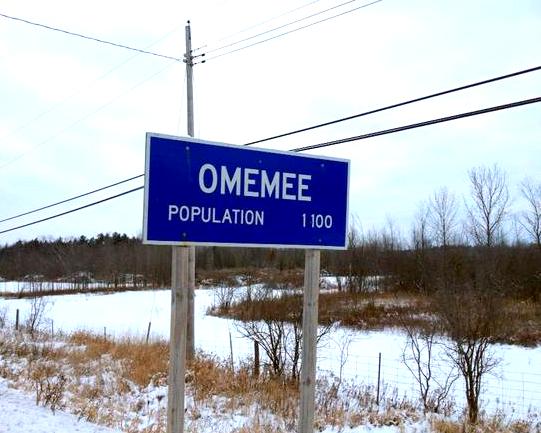
It's one of the communities within the "city" of Kawartha Lakes, Ontario.
It's named for the Omemee people, who once hunted in the area. Omemee
is a Mississauga word that means "pigeon".
Soon after Neil Percival Young was born in Toronto in 1945,
he moved to Omemee, with his father Scott, mother "Rassy"
and brother Bob.
Long after he'd moved to California Neil describe it fondly
as a "sleepy little place".
He suffered from a bout of polio in 1951, in what was the last
major outbreak of the disease in Ontario. Curiously, a thousand
miles away, future Canadian songwriter Joni Mitchell, then aged
nine, also contracted the virus in this epidemic.
Neil (left) and his bother Bob (right)
In 1960, his mom and dad split up. Bob stayed with his father
in Toronto and Neil went to live with his mom in Winnipeg.
He was already deeply fascinated by music - his most treasured
possessions were a blue transistor radio and a plastic ukelele.
But he'd be back...
Neil (left) and his bother Bob (right)
Two Towns, One Song...?
People from Omemee would say that when Neil and his friend
Jonathan Demme made the film Journeys, they drove in his
1956 Crown Victoria from Omemee to downtown Toronto's
iconic Massey Hall where he performed the last two nights
of his solo world tour.
Thunder Bayers mention how Neil met Steven Stills in their town,
and that he's probably never even heard of Omemee.
Omemeers might point to the Omemee's Youngtown Rock & Roll Museum
and ask (somewhat rhetorically) if there was one in Thunder Bay?
Thunder Bayers might pull out a map, noting that they live
at 48° 38' North latitude and that Omemee, at 44° 18' 0" North
latitude, is not even IN north Ontario*.
* In rural Ontario, there is an understated understanding that Ontario is divided into two unequal parts- south of 7, and north of 7. Omemee straddles Highway 7.
Omemeers might say "Oh yeah? We have a postcard".
Thunder Bayers might point out how Alice Cooper once played
at the drive-in there which proves they totally rock.
Then people from Omemee might slap the table like they were
playing the Jack of Spades in a euchre tournament, and shout
"Neil Young said so".
But did he? In classic Canadian fashion, the answer is yes... and no.
When the question was put to him in an interview with Nick Kent
from Mojo magazine in 1995, Neil did say "Omemee, Ontario"
but - and it's a big but - here is that response in context:
"Well, it's not literally a specific town so much as a feeling. Actually, it's a couple of towns. Omemee, Ontario, is one of them. It's where I first went to school and spent my 'formative' years. Actually I was born in Toronto... *I was born in Toronto*... God, that sounds like the first line of a Bruce Springsteen song (laughs). But Toronto is only seven miles from Omemee."
Well, there's a bit of artistic license here - Toronto is actually
130 kilometers from Omemeee, which works out to about 81 miles -
but that aside, it sounds like both towns are at the heart of this essential
Canadian song, and maybe even a few others.
It also wouldn't come as a surprise if kids growing up somewhere
off the map in Montana or Saskatchewan or South Dakota or any
number of other places felt like the song was about where they grew up too.
And somewhere out there, a Winnipegger is reading this and muttering
"he might have set the song in Ontario, but he wrote it HERE".